


T : 1-800-447-0515
T : 1-800-447-0515

There’s a big difference between printing a part that looks good on a workbench and printing one that survives actual use.
That’s why material testing matters.
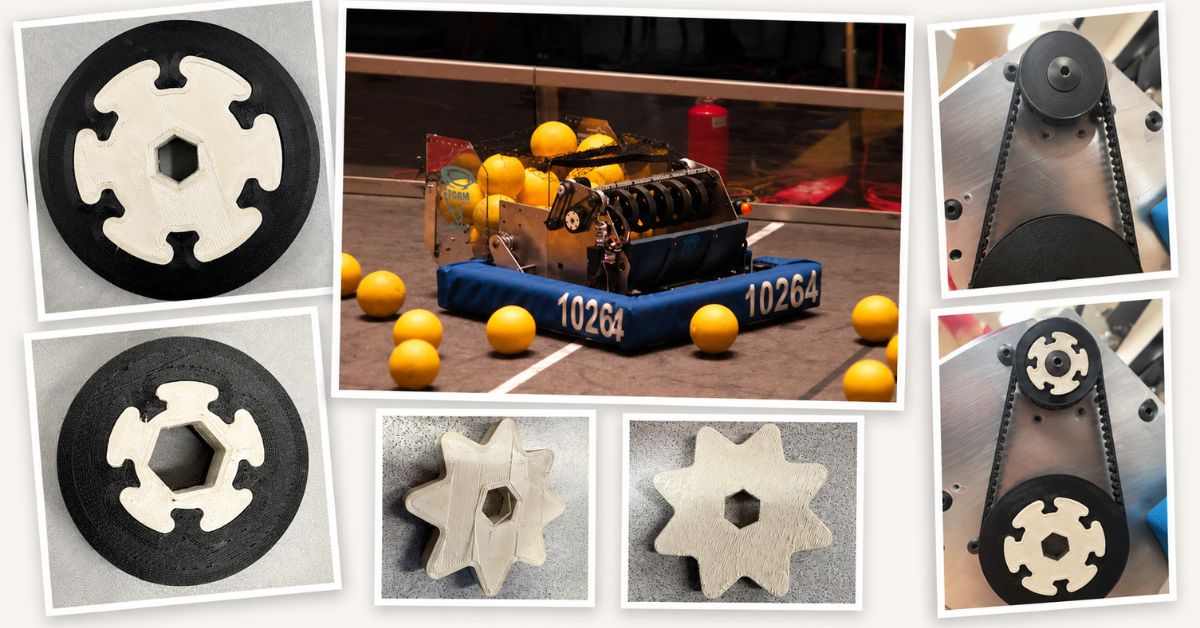
A recent Tullomer evaluation gave us the opportunity to look at the material from several angles, including printability, surface quality, part design, dimensional tolerance and real-world performance. The test ultimately moved beyond sample prints and into functional pulley components installed on FRC10264’s 2026 competition robot.
The results were promising, but they also showed exactly where design strategy and printer capability matter.
Testing was performed on a Bambu Lab X1E using a modified version of the profile available from Z-Polymers.
The infill percentage was reduced to 98%, while printhead speed was standardized at 120 mm/s. That speed produced the best balance between print quality and layer adhesion during testing.
First-layer adhesion proved more difficult.
The initial layer speed was eventually increased to match the rest of the print in an effort to reduce temperature differences between layers. That helped, but it didn’t eliminate the issue. Several prints still lost their first layer, and in some cases, delamination during printing caused the part to warp.
Top-surface quality presented another challenge. Adjustments to flow rate and other print settings helped only marginally on larger parts. Smaller components produced noticeably better surface finishes, suggesting that access to higher nozzle temperatures could improve results when printing larger Tullomer parts.
Testing also produced two significant failures while using 0.4 mm nozzles. One involved the nozzle being pushed completely out of the hot end. The second resulted from a material backup that ultimately encased the hot end in filament.
That’s the value of testing a material hard. You find the limits before the application does.
The first pulley prototypes were printed entirely from Tullomer.
They worked, but detailed pulley teeth didn’t print particularly well on the X1E. Rather than forcing the material into an application where fine detail was becoming a limitation, the design changed.
The solution was a hybrid approach.
Tullomer was used as an insert around the hex bore, where its stiffness could help address a known weakness in Onyx parts. Onyx remained around the outside of the pulley, where it could reproduce the detailed tooth geometry more cleanly.
That design also allowed the better-quality bottom surface of the Tullomer insert to remain visible while the rougher top surface was pressed into the surrounding component.
The original star-shaped insert was later replaced with a “dog bone” design that created a tighter fit.
This is where additive manufacturing gets interesting. Material selection is only part of the equation. Geometry, tolerances, print orientation and material combinations can matter just as much.
The final pulleys weren’t display pieces.
They were installed on FRC10264’s 2026 competition robot, replacing Onyx components in a 1:2 pulley system. The motor operates at approximately 4,257 RPM, with the driven system running at approximately 2,128.5 RPM after reduction.
That system is used to fire foam rubber balls from the robot, processing roughly 15 to 20 balls in six to 10 seconds.
The Tullomer-equipped parts held up through competition.
Post-competition inspection showed some material flaking, but the test concluded that the damage appeared superficial and was likely tied to low layer adhesion combined with very tight tolerances around the hex bore. Better bore tolerancing and higher hot-end temperatures were identified as likely ways to improve future results.
That tolerance point matters.
Tullomer didn’t behave exactly like Onyx or PLA. The report specifically noted that bore tolerances need to be tested for the material rather than carried over from designs developed around other polymers.
One of the more useful conclusions from the project wasn’t simply whether Tullomer “worked.”
It was where the material appeared to make the most sense.
Based on the testing, its strength and stiffness may make it better suited to larger structural components than small functional parts requiring very fine printed detail. The report also identified multi-material printing as a preferred future direction, allowing Tullomer to be embedded directly into another printed material instead of relying on a press-fit insert.
There is also a cost consideration.
For the 48-tooth pulley tested, the Onyx-only version was calculated at $8.59, compared with $18.81 for the Onyx and Tullomer version. For the smaller 24-tooth pulley, the comparison was $2.81 versus $4.28.
Tullomer wasn’t the cheaper option.
But material cost isn’t the only number that matters when a component’s stiffness, dimensional stability or service life can change the economics of the part.
Advanced materials don’t remove the need for good engineering. They make it more important.
This project exposed print limitations, changed the part design, highlighted material-specific tolerance requirements and ultimately produced components that survived competition use.
That’s useful data.
And for STS Additive Manufacturing, that’s the point.
We don’t just want to know whether a material can be printed. We want to understand where it works, where it struggles and how the design can change to take advantage of what the material does best.
Have a component, material or application you want to put through its paces? Contact STS Additive Manufacturing to start the conversation.